Congo Coffee and the Future of Fair Trade - A review of the past 10 years of Higher Grounds Coffee work in the Democratic Republic of Congo
Explore the decade-long transformation of Congo's coffee industry. Learn how Higher Grounds Coffee promotes sustainable and fair trade coffee through community-based investments.
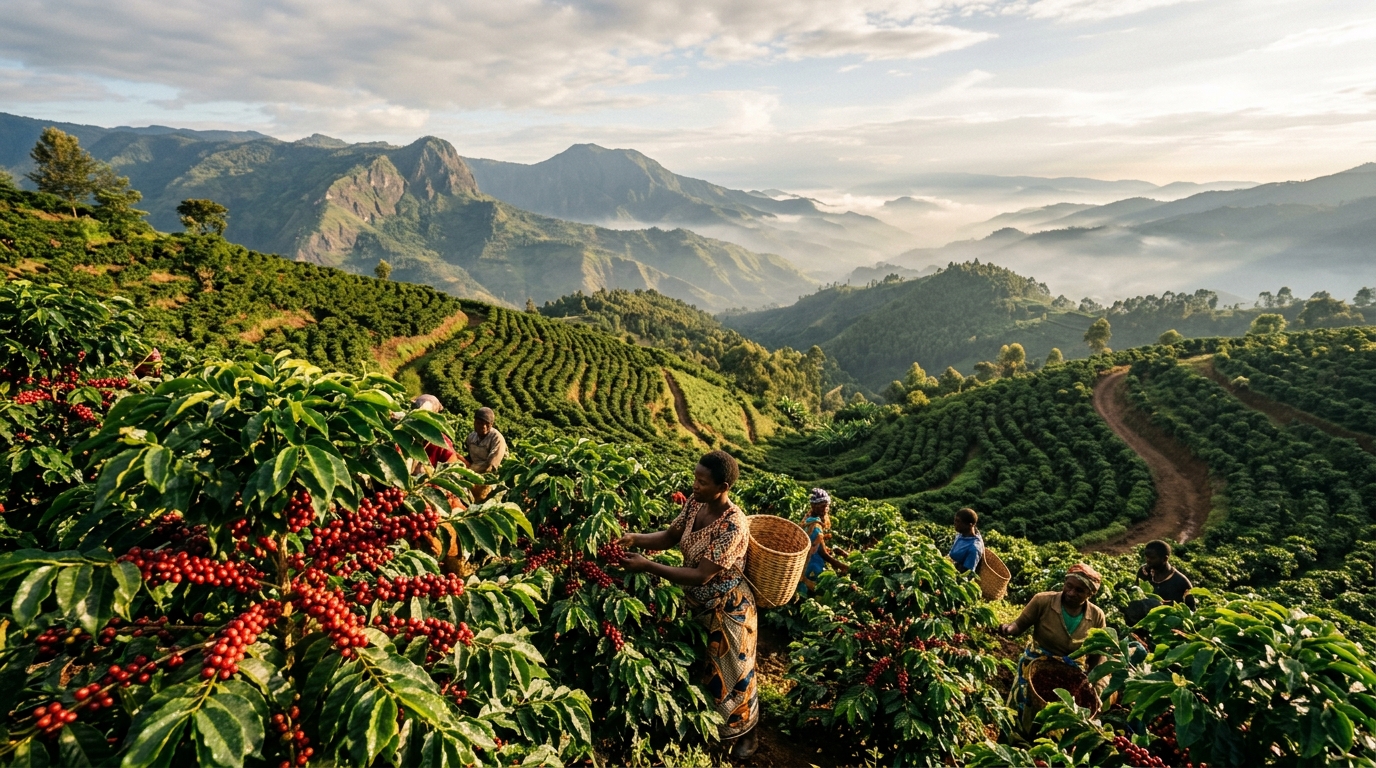
Over the past decade (2014–2026), the Democratic Republic of Congo (DRC) has undergone one of the most remarkable agricultural transformations in the world. Once a dominant global producer whose infrastructure was decimated by decades of civil conflict and economic instability, eastern DRC—particularly the volcanic, high-altitude region of South Kivu—has rapidly re-emerged as a high-value origin for world-class Arabica beans. This resurgence is reshaping expectations for modern trade coffee models and proving that long-term, community-based investments yield superior economic and agricultural results.
At the vanguard of this movement is Higher Grounds Trading Co., a B Corp certified roaster based in Traverse City, Michigan. Through a ten-year blueprint of continuous direct purchasing, emergency climate response, and human-centered sustainability, their work in the DRC offers a vital case study. As specialty coffee companies navigate an era of climate volatility and shifting consumer demands, this decade of progress illuminates the future of fair trade coffee and transparent supply chains in East Africa.
What is the Current State of Coffee Production in the Democratic Republic of Congo?
The Democratic Republic of Congo currently produces over 62,000 metric tons of green coffee annually, marking a staggering recovery from a historic low of just 5,000 metric tons in the early 2000s. According to FAOSTAT and market research data, domestic unroasted coffee volumes peaked at 62,405 tonnes in 2023. By that same year, official export valuations reached $18.3 million—a 199% year-over-year growth compared to prior periods, according to UN Comtrade data.
This agricultural rebound marks the end of a dark era for Congolese farmers. In 1990, the DRC exported a robust 120,000 metric tons of coffee. However, 25 years of armed conflict nearly erased the sector. Without access to formal export channels or local washing stations, growers were forced to smuggle their harvests. As documented in Eastern Congo: The Last Bastion of Specialty Coffee, thousands of smallholder farmers resorted to moving green coffee across Lake Kivu at night in wooden canoes to sell in neighboring Rwanda or Uganda—a dangerous journey that cost hundreds of farmers their lives over a 30-year period.
Today, approximately 250,000 smallholder coffee farmers in North and South Kivu rely on coffee as their primary household income, cultivating average landholdings of 1.5 hectares per farmer.
How Direct Trade is Transforming South Kivu
True supply chain resilience requires moving beyond transactional purchasing and establishing relational, multi-year commitments. Recognizing the exceptional microclimates and altitudes (1,400 to 2,000 meters) of South Kivu, Higher Grounds established a continuous direct-trade relationship with the Muungano Cooperative in 2013–2014.
Meaning "togetherness" in Swahili, the Muungano Cooperative successfully united smallholders from different ethnic groups—including Kirundi, Kihavu, and Kinyarwanda speakers—who were previously divided by conflict. This enduring partnership yields exceptional coffees like the DR Congo Muungano, known for its cupping notes of almond, Meyer lemon, and a buttery finish, alongside exclusive microlots like DRC Majirane Organic.
Saveur du Kivu: Elevating the Origin
To catalyze the regional market, a coalition of stakeholders launched Saveur du Kivu in 2015. Co-founded by Higher Grounds (via its non-profit arm, On The Ground Global) alongside the Eastern Congo Initiative, ÉLAN RDC, and the South Kivu provincial government, this event was the first official specialty coffee cupping competition in DRC history.
Saveur du Kivu fundamentally altered the trajectory of Congolese coffee by bringing international buyers, government officials, and smallholder farmers together on equal footing. By showcasing high-scoring Congolese lots, the event successfully drove up export prices and began attracting international specialty coffee companies from North America, Europe, and Asia.
Traditional Fair Trade Coffee vs. Human-Centered Sourcing
While traditional fair trade coffee certification provides an essential baseline by establishing a price floor and community premium, the past decade in the DRC proves that deeper interventions are necessary for true sustainability.
Dimension | Traditional Fair Trade Model | Integrated Human-Centered Model |
|---|---|---|
Pricing Mechanism | Base C-market price + minimum premium ($0.20/lb). | Direct-trade pricing negotiated well above market minimums based on quality and cup score. |
Supply Chain Relationship | Often transactional through intermediaries; origins may change annually. | Long-term, multi-decade direct partnerships (e.g., 11+ consecutive years with Muungano). |
Social Investment | Premium managed by a cooperative committee for general public projects. | Target-funded projects (e.g., gender equity frameworks, rapid disaster relief, clean water). |
Transparency & Governance | Standard audit-based certification. | B Corp certified accountability and direct, farm-level reporting. |
Empowering Women Through the GALS Framework
Women perform a disproportionate share of agricultural labor in East African coffee cultivation, yet they historically face social marginalization. To address this, the Gender Action Learning System (GALS) was implemented within the Muungano cooperative.
Through community workshops and joint household budgeting, GALS helps couples map out shared financial goals. This has led to joint land registration, shared coffee revenue management, and greater household equity. As Riziki Kacheranga, a 32-year-old mother from the Nyabirehe sector, explained: "The GALS is more important than food, money, and distributions that NGOs are giving in their communities... thanks to it I have started to build my own iron sheets house according to the vision and determination I took two years ago."
Climate Resilience and Rapid Emergency Response
In May 2023, extreme weather events driven by climate change triggered catastrophic flash floods and landslides in South Kivu's Kalehe territory. Over 400 people died, and 50,000 were displaced, directly impacting the Muungano cooperative's farming villages.
While international aid struggled to navigate damaged infrastructure, direct-trade relationships enabled immediate action. As detailed in the Urgent Aid Update, independent fundraising mobilized emergency relief—funding food, medical care, and shelter kits for over 600 farming families in a fraction of the time it took traditional NGOs to arrive.
What is the Future for Coffee Companies Operating in East Africa?
As we look toward the remainder of 2026 and beyond, coffee companies must adapt to shifting consumer priorities and increasing environmental pressures. The successful revitalization of the DRC's coffee sector offers three critical strategic insights:
Radical Transparency Over Badge Marketing: Modern consumers look beyond basic certification logos. Establishing authority requires publishing verifiable impact metrics, maintaining multi-year origin commitments, and investing directly in farming communities.
Gender Equity as an Economic Lever: Empowering female producers directly correlates with higher coffee quality and improved yield management. Frameworks like GALS serve as essential risk-mitigation tools for agricultural cooperatives.
Cross-Sector Collaboration: As noted in a recent sustainability series, the future of the industry relies on aligning values to transcend competition. Shared learning and collaboration across the supply chain offer profound benefits that isolated markets simply cannot match.
The past decade in the Democratic Republic of Congo demonstrates that coffee can be far more than a commodity. When trade coffee is rooted in human-centered development and steadfast collaboration, it becomes a powerful engine for peace, equity, and exceptional agricultural quality.