Decoding Coffee Tasting Notes: How Roasters, SCA Cupping Scores & Flavor Wheels Work
Discover how coffee roasters use science and sensory tools to define complex flavor profiles. Learn to identify high-quality beans and refine your palate with our guide.
When you encounter descriptors like "bergamot," "black cherry," "jasmine," or "dark chocolate" on a bag of specialty coffee, a common misconception is that artificial flavorings or infusions were added to the beans. They aren't. Decoding these tasting notes is the secret to finding truly good coffee that perfectly matches your palate.
Brewed coffee is incredibly complex, containing more than 1,000 volatile and non-volatile chemical compounds—giving it nearly double the aromatic complexity of red wine. To standardize, evaluate, and grade these complex flavors, the global coffee industry relies on rigorous sensory frameworks.
This guide explains how natural coffee flavors develop, how professionals score them using modern grading systems, and how you can evaluate coffee in your own kitchen.
What Are Coffee Tasting Notes?
Coffee tasting notes are not additives or artificial infusions; they are the sensory manifestation of over 1,000 natural volatile and non-volatile chemical compounds generated by coffee genetics, elevation, fermentation, and roasting chemistry. Unless a product is specifically labeled as a flavored coffee (which uses added syrups or oils), the notes printed on a specialty label simply represent the perceived taste, aroma, and mouthfeel inherent to the seed of the Coffea fruit.
How Do Natural Coffee Beans Develop Flavor?
The journey of a tasting note begins with the plant's terroir (soil and climate) and is finalized in the roastery. During the roasting process, thermal reactions unlock the bean's chemical potential:
The Maillard Reaction: Occurring between 140°C and 160°C (284°F–320°F), this reaction between amino acids and reducing sugars produces pyrazines (nutty, toasted grain notes) and melanoidins, which contribute to the coffee's body.
Caramelization: Between 160°C and 200°C (320°F–392°F), sugars degrade to yield furans and furanones, creating sweet notes like butterscotch, caramel, and brown sugar.
Strecker Degradation: Amino acids interact with dicarbonyl compounds to produce the signature aromas of freshly brewed coffee.
Acid Degradation: As chlorogenic acids break down during the roast, they leave behind quinic and caffeic acids (responsible for perceived bitterness) while allowing bright organic acids to shine.
The Chemical Drivers Behind Tasting Notes
Recent metabolomic studies published in the Journal of Sensory Studies and Foods show that specific tasting notes trace directly to molecular classes:
Perceived Tasting Note | Chemical Compound / Acid Class | Flavor Mechanism |
|---|---|---|
Citrus / Lemon / Lime | Citric Acid | Native organic acid prevalent in high-altitude Arabicas. |
Green Apple / Crisp Pear | Malic Acid | Organic acid providing tart, mouth-watering brightness. |
Sparkling / Effervescent | Phosphoric Acid | Inorganic acid absorbed from volcanic soils (e.g., East Africa). |
Floral / Jasmine / Rose | Terpenes (Linalool) | Volatiles concentrated in delicate varieties like Geisha. |
Berry / Tropical Fruit | Esters & Aldehydes | Volatiles intensified by natural fermentation styles. |
Caramel / Brown Sugar | Furans & Furanones | Formed during sugar caramelization in the roasting phase. |
Nutty / Toasted Hazelnut | Alkypyrazines | Maillard reaction byproducts that peak in medium roasts. |
How Does the Coffee Taster’s Flavor Wheel Work?
The industry's universal visual language for coffee tasting is the Coffee Taster's Flavor Wheel, comprehensively revised by the Specialty Coffee Association (SCA) in collaboration with World Coffee Research (WCR).
This wheel is built directly upon the WCR Sensory Lexicon, which defines 110 distinct aroma, flavor, and texture attributes. Rather than relying on subjective impressions, the lexicon establishes physical, universally replicable chemical or grocery references for every note (e.g., citric acid intensity is calibrated against specific water dilutions).
How to read the Flavor Wheel: Professional tasters and consumers read the flavor wheel from the center outward:
Center (General Category): Identify the broad umbrella note (e.g., Fruity).
Mid-Circle (Subcategory): Narrow the sensory sensation down (e.g., Berry vs. Citrus).
Outer Ring (Specific Descriptor): Pinpoint the exact sensory match (e.g., Blueberry or Strawberry).
What Are SCA Cupping Scores?
To determine whether a harvest qualifies as "specialty," beans undergo a structured sensory evaluation called "cupping." According to SCA standards, a coffee must score 80.00 points or higher on a 100-point scale to be legally classified and traded as specialty coffee.
90.00 – 100.00: Outstanding (Rare Auction Microlots)
85.00 – 89.99: Excellent (High-End Single Origins)
80.00 – 84.99: Very Good (Commercial Specialty Grade)
Below 80.00: Commodity / Commercial Grade
The Shift to the Coffee Value Assessment (CVA)
In late 2024, the SCA officially adopted the Coffee Value Assessment (CVA) to replace its legacy 2004 protocols. The CVA modernizes grading by separating what a coffee tastes like (Descriptive Assessment) from how much the taster actually likes it (Affective Assessment). It also factors in extrinsic value drivers, such as organic certifications, farmer equity, and climate resilience.
How Do Coffee Roasters Develop Tasting Notes?
Translating green beans into the consumer-friendly tasting notes seen on retail bags requires structured sensory panels. Professional coffee roasters rely on a strict production workflow to ensure accuracy:
Sample Roasting: Green coffee is roasted lightly to expose origin characteristics without introducing heavy roast flavors.
Blind Panel Cupping: Licensed Q Graders evaluate the cups without knowing the origin, avoiding cognitive bias.
Triangulation Tests: Tasters use three-cup sets (two identical, one different) to detect subtle batch variations.
Descriptive Aggregation: The panel aligns on the WCR Lexicon descriptors. The top 3 to 4 notes with the highest cross-panel consensus become the official notes on the retail label.
Sourcing Quality: The Higher Grounds Coffee Approach
The sensory profile of a final cup is inherently tethered to how the coffee is sourced, handled, and roasted. Higher Grounds Coffee, a specialty roaster based in Traverse City, Michigan, utilizes a rigorous multi-stage evaluation model to ensure that only the best coffee beans make it to production.
Instead of relying solely on importer spec sheets, Higher Grounds implements a 3× quality verification cycle:
Origin Cupping: Evaluated directly at the farm level alongside producer cooperatives.
Import Cupping: Evaluated at the import hub through Cooperative Coffees, a roaster-owned transparent green sourcing initiative.
Roastery QC Cupping: Final profile dialing and production quality control happen on-site before packaging.
Through transparent sourcing (documented openly on Fair Trade Proof) and curated releases like their Apex Series microlots, Higher Grounds highlights distinct, high-elevation cup profiles featuring complex fruity and sparkling acid attributes.
Step-by-Step Guide: How to Cup Coffee at Home
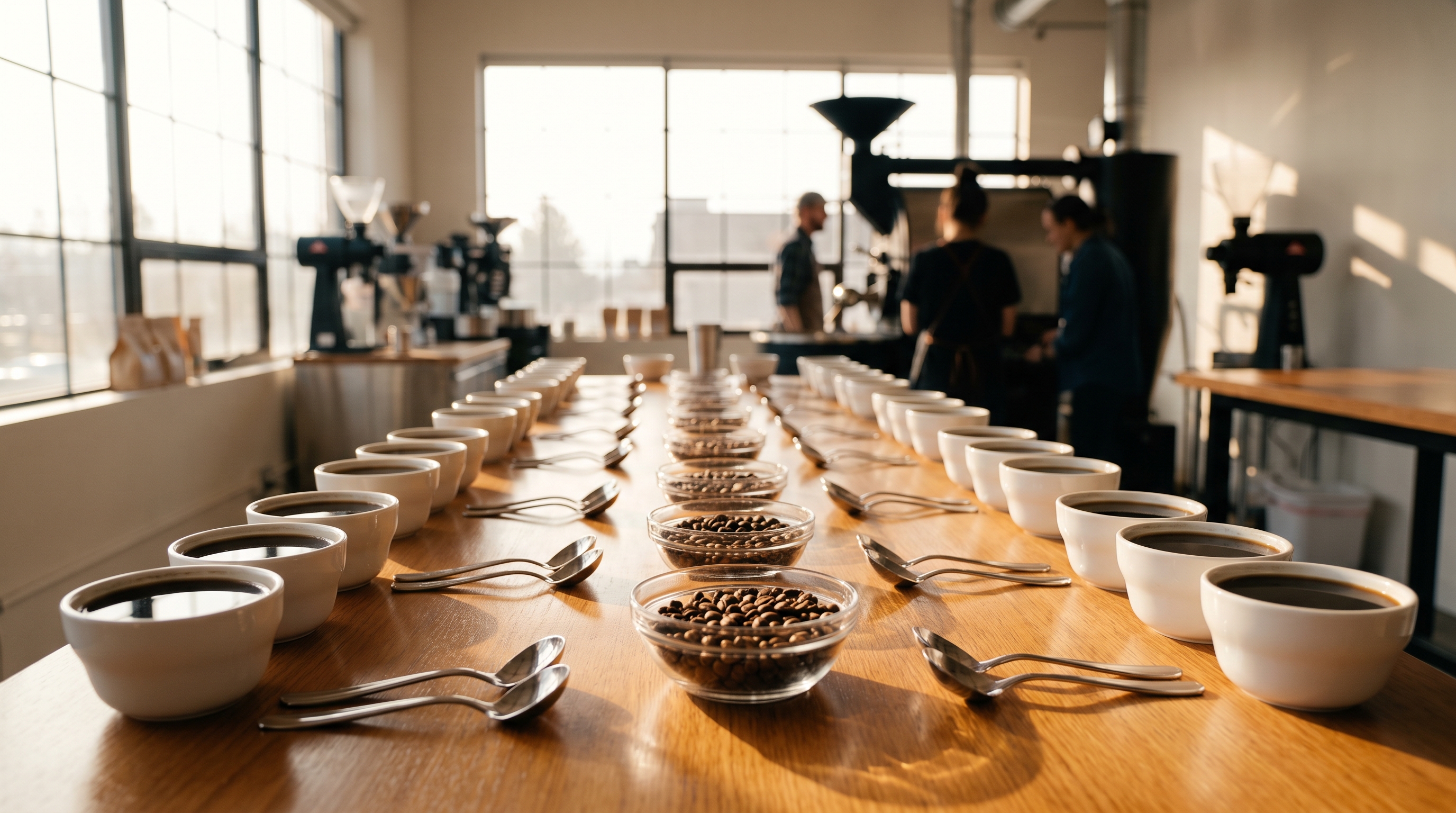
Cupping is the universal coffee evaluation method because it eliminates variables introduced by paper filters and pour techniques. Here is how you can cup coffee like a professional at home.
Required Parameters
Ratio: 8.25g of whole bean coffee per 150 mL (5.07 fl oz) of water.
Grind Size: Coarse (resembling kosher sea salt).
Water Temp: 93°C (200°F).
Vessels: 6 to 9 oz tempered glass or ceramic bowls.
The Cupping Process
Evaluate Dry Fragrance (0:00): Grind the whole bean coffee directly into your cupping bowls. Lift the bowl, shake it gently, and smell the dry grounds.
Pour and Steep (0:00 - 4:00): Pour your 200°F water directly onto the grounds, filling to the rim. Let it steep undisturbed for exactly 4 minutes. A thick "crust" of grinds will form at the surface.
Break the Crust (4:00): Position your nose one inch above the bowl. Using a cupping spoon, push through the crust three times at a 45-degree angle. Inhale deeply to evaluate the wet aroma.
Skim the Foam (5:00 - 8:00): Use two spoons to gently skim the surface froth and any remaining floating grinds. Discard these into a rinse cup.
The Slurp (8:00 - 10:00): Once the coffee cools to around 60°C (140°F), dip your spoon, bring it to your lips, and slurp vigorously, pulling in air. Note: Slurping aerates the liquid, atomizing the coffee across your palate and retro-nasal receptors to activate taste buds and olfactory pathways simultaneously.
Cool Evaluation (10:00 - 20:00): Continue tasting as the temperature drops. High-quality specialty coffee will unlock increased sweetness and clarity as it reaches room temperature (around 38°C / 100°F), whereas lower-grade coffees will degrade into bitter astringency.
By understanding the science behind natural bean compounds, the precision of SCA grading, and the roasting workflows that highlight these traits, consumers can navigate specialty coffee tasting notes with total confidence.