Equipping Your Cafe: How Wholesale Coffee Partners Provide Brewing Equipment & Technical Support
Discover how a professional coffee supplier can streamline your operations through expert equipment sourcing and technical support. Learn to build a successful cafe program with reliable wholesale partners.
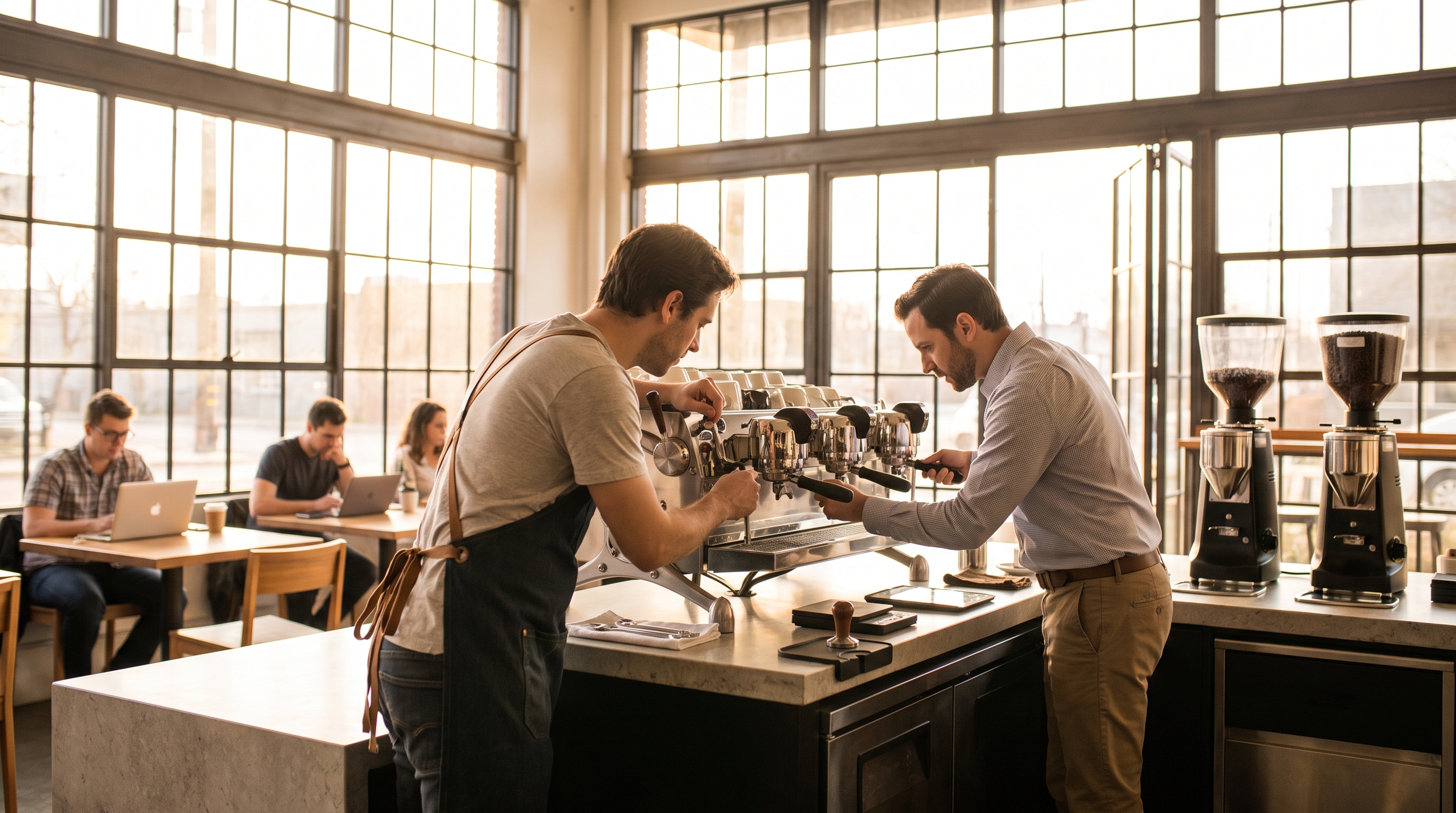
Opening and scaling a successful specialty cafe requires far more than ordering bags of roasted beans. In 2026, the financial health and daily operational success of a coffee program rely heavily on commercial espresso machinery, precision grinder calibration, water chemistry, and rapid technical support. According to recent foodservice industry research, equipment downtime is the second leading cause of lost sales in specialty coffee operations, trailing only broader supply chain disruptions.
Because commercial espresso setups routinely command between $15,000 and $40,000 in upfront capital expenditure, experienced operators increasingly lean on a consultative coffee supplier to source hardware, design workflows, train staff, and manage preventative maintenance. This guide explores how to evaluate equipment needs and choose a wholesale partner that supports your business from seed to cup.
What is a Full-Service Coffee Shop Supplier?
A full-service coffee shop supplier is a wholesale roasting partner that provides comprehensive operational support alongside regular coffee deliveries. Rather than simply shipping roasted beans, these partners function as technical consultants. They help cafes procure tier-one commercial brewing equipment, engineer ergonomic bar layouts, conduct local water testing, and provide ongoing preventative maintenance to ensure maximum uptime.
The Core Equipment Suite: Espresso Machines, Grinders & Water Treatment
A commercial café setup is an integrated ecosystem where a failure in any single component compromises extraction quality, customer throughput, and profitability. Building a reliable bar requires investing in three primary pillars.
Commercial Espresso Machinery
Modern specialty cafes require commercial espresso machines built for thermal stability and high-volume repeatability. Independent brew and steam boilers equipped with digital Proportional-Integral-Derivative (PID) temperature controllers ensure brew water remains stable within fractions of a degree, even during consecutive rush hours.
Furthermore, while standard volumetric machines dose water by pulse flowmeter, newer gravimetric models incorporate integrated scales directly into the drip tray. This automates the brew ratio in real time, eliminating shot-to-shot variance caused by barista error. The most reputable wholesale programs primarily represent commercial manufacturers such as La Marzocco, Synesso, Slayer, Sanremo, and Nuova Simonelli.
Precision Grinder Setup & Calibration
A common maxim in specialty coffee holds that the grinder dictates shot consistency far more than the espresso machine itself. The industry technical consensus highlights that burrs dull gradually and alignment drifts without announcement, leaving baristas chasing extraction issues that are purely mechanical in origin, as noted by Crimson Cup.
Commercial grinders feature hardened steel or titanium flat burrs ranging from 64mm to 98mm. Larger burrs disperse heat more effectively, preventing premature flavor degradation and thermal drift during continuous service. Additionally, Grind-by-Weight (GbW) load-cell technology has become a standard in 2026, dosing coffee within 0.1 grams of accuracy in under three seconds.
Commercial Water Filtration
Water comprises 98% of brewed coffee and approximately 90% of espresso, making it the primary driver of commercial equipment breakdowns. Mineral scale (calcium carbonate and magnesium) accounts for the vast majority of commercial espresso machine failures, precipitating onto heating elements and locking three-way solenoid valves.
Authoritative technicians specify that café water supplies maintain total dissolved solids (TDS) of 75–150 ppm, zero chloramines, total hardness between 50–100 ppm, and an alkaline buffer to avoid acidic boiler corrosion. Installing a commercial reverse osmosis (RO) system with a blending remineralization valve typically pays for itself within 12 to 18 months by eliminating emergency descaling repairs, according to KitchenRepairHub.
Equipment Acquisition Models: Buy vs. Lease vs. Loan
When evaluating prospective coffee shop suppliers, operators must assess three prevailing equipment procurement pathways. Each comes with distinct tax and cash flow implications.
Procurement Model | Upfront Capital Required | Ongoing Monthly Commitment | Ideal For |
|---|---|---|---|
Outright Capital Purchase | High ($15,000–$40,000+) | None (Standard wholesale bean pricing) | Established operators with cash reserves seeking IRS Section 179 write-offs and zero bean-volume contracts. |
Third-Party Equipment Lease | Low to Moderate ($0 down or 1st/last month deposit) | Fixed monthly payment over 24–60 months | Startups wanting to conserve working capital while retaining flexibility to upgrade machinery, a model supported by partners like Queen City Coffee Roasters. |
Roaster Equipment Loan | Nominal (Setup/security deposit) | Bound by strict weekly coffee purchase minimums | High-turnover concepts preferring zero asset liability, though roasters often offset costs with higher per-pound bean surcharges. |
Preventative Maintenance Schedules and Downtime Costs
Café profitability is uniquely vulnerable to mechanical halts. An espresso machine failure on a weekend morning directly costs cafes $500 to $2,000+ per day in lost revenue, in addition to tarnishing customer goodwill. Travis Estes, CEO of Busy Bean Coffee, notes that the single most common budgeting blind spot for new operators is failing to account for the $3,000 to $5,700 required in annual preventative maintenance per espresso machine in 2026 (Busy Bean Coffee).
A robust maintenance partnership should include:
Daily In-House Maintenance: Backflushing group heads, purging steam wands, and sanitizing grinder hoppers.
Quarterly Partner Service: Replacing group gaskets (silicone vs. rubber) every 3-6 months, testing dynamic line pressure, and checking water filter saturation.
Biannual/Annual Overhauls: Replacing standard espresso burrs after grinding 600–1,000 kg of coffee, rebuilding steam valves, and inspecting heating elements for scale mitigation.
How Higher Grounds Integrates Equipment and Education
When selecting an ethical, high-touch wholesale partner, operators should look for brands that bridge origin transparency with commercial execution. Based in Traverse City, Michigan, Higher Grounds Coffee exemplifies this model. As Michigan's first coffee roaster to achieve B Corp certification (2016) and a member-owner of Cooperative Coffees, they pair their high-elevation microlots with deep structural support for cafe operators.
Rather than treating equipment as a purely commercial transaction, Higher Grounds pairs machinery procurement with formal barista and operator education through its dedicated facility, The Learning Lab. Staffed by an Authorized SCA Trainer (AST) and a Licensed Q Grader, Higher Grounds bundles custom partner training packages with commercial machinery installations. This ensures that a cafe's staff knows exactly how to dial in roasts, diagnose extraction issues, and perform routine daily preventative maintenance to protect machinery life.
What to Look for in Suppliers for Coffee Shops
Operators evaluating potential suppliers for coffee shops should use a strict scorecard to assess technical competencies. Ensure your chosen coffee supplier meets these six criteria:
Authorized Dealer Network: They should represent Tier-1 brands (e.g., La Marzocco, Mahlkönig, Fetco) to guarantee warranty protection and OEM parts access, similar to the standards outlined by Dilworth Coffee Supply.
Ergonomic Bar Layout Consulting: Assistance with electrical mapping, drain pitch, and workflow staging.
Dedicated Water Diagnostic Testing: On-site analysis of local municipal water before specifying filtration systems.
Emergency Response SLAs: Guaranteed sub-24-hour technician dispatch for critical mechanical failures.
Accredited Barista Instruction: Ongoing, AST-led extraction and dialing-in curriculum, rather than a brief opening-day walkthrough.
Transparent Pricing Models: Clear differentiation between wholesale coffee bean pricing and equipment amortization surcharges.
Partnering with a specialized wholesale roaster transforms equipment from a stressful liability into a reliable engine for growth. By prioritizing technical support, preventative maintenance, and staff education over beans alone, cafe owners can protect their capital investments and ensure consistently exceptional service.