Producer Price Transparency in Specialty Coffee: Understanding FOB, Living Wages & Farmgate Contracts
Discover how leading coffee companies are prioritizing economic equity. We explore the essential differences between FOB and farmgate pricing to ensure your daily cup supports a sustainable, transparent, and fair-trade specialty coffee supply chain.
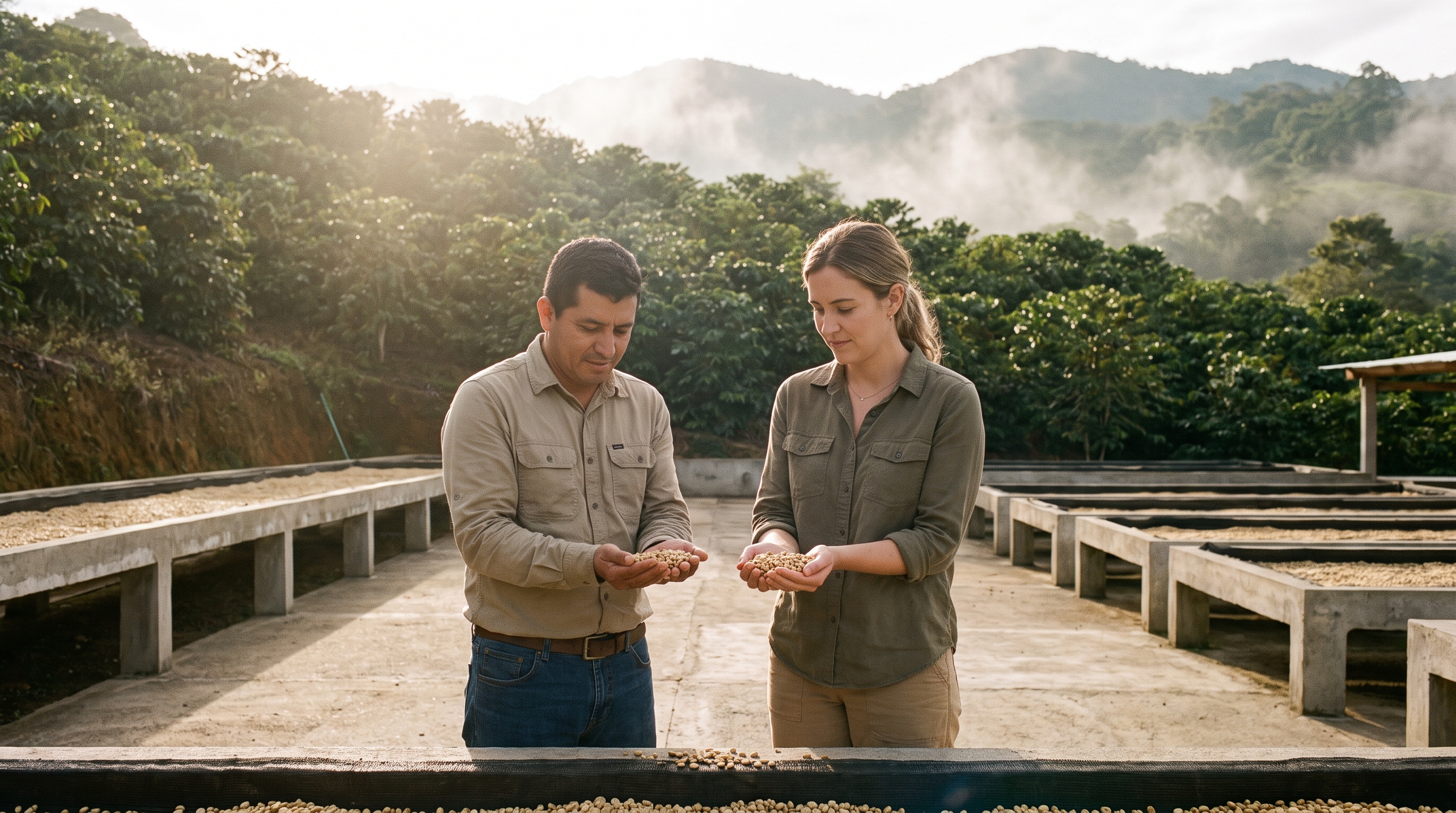
The specialty coffee sector faces a critical transparency challenge in 2026: while consumer-facing marketing often highlights ethical sourcing, the underlying financial mechanics remain largely opaque. For smallholder growers, who produce over 60% of the world's coffee, volatile commodity benchmarks consistently fail to reflect the true costs of production, climate adaptation expenses, or local living wage requirements. As leading coffee brands transition from vague sustainability claims to verifiable economic models, understanding the critical differences between export prices and actual farmer income is essential. By decoupling green coffee purchasing from speculative markets and prioritizing published price transparency, pioneering coffee companies are proving that structural equity in the supply chain is both achievable and necessary.
What is FOB vs. Farmgate Pricing in the Coffee Trade?
To evaluate whether a trade coffee purchase truly supports producer livelihoods, buyers and roasters must distinguish between the distinct stages where coffee is priced and transacted. The industry standard often relies on export pricing, which leaves a critical visibility gap regarding what farmers actually earn.
Free On Board (FOB) Pricing
Free On Board (FOB) represents the price paid for green coffee loaded onto a cargo vessel at the origin port. As outlined by the Specialty Coffee Transaction Guide, FOB is a standardized, auditable international commercial term (Incoterm) that covers the farmgate price, wet and dry milling operations, quality sorting, domestic transit, and exporter operating margins. While FOB serves as a valuable international benchmark, it excludes international ocean freight and import tariffs. Furthermore, a pricing analysis by Perfect Daily Grind notes that a high FOB price can sometimes mask severe margin extraction by local intermediaries, leaving the actual growers underpaid.
Farmgate Pricing
Farmgate refers to the actual cash amount received by the coffee farmer for raw cherry or parchment coffee at the farm or cooperative wet mill. Farmgate pricing is the sole metric that directly determines household income, farm reinvestment, and labor compensation for pickers. Unlike FOB, farmgate is not an Incoterm. As detailed in Algrano's FOB breakdown and Royal Coffee's smallholder study, farmgate prices fluctuate based on the processing stage and currency exchange rates. Verifying farmgate income requires direct, transparent relationships with grower organizations rather than simply relying on exporter invoices.
How Does the "C" Market Volatility Impact Coffee Companies?
The New York ICE Arabica "C" futures market serves as the global price benchmark for commercial coffee. However, the C price is driven by institutional currency speculation, macroeconomic cycles, and mass-scale monoculture output—factors completely unrelated to smallholder production realities in differentiated microlot origins.
When coffee companies negotiate based on a "C + differential" model, farmer incomes collapse during commodity downturns, even if the coffee quality remains exceptional. According to the 2024 Specialty Coffee Transaction Guide, which aggregated data from over 100,000 contracts and 2 billion pounds of specialty green coffee, the median FOB price across recent harvest cycles was $3.48/lb, with higher-scoring lots averaging $4.18/lb. This data reinforces the assertion of SCTG Founder Peter Roberts: "Pricing for green specialty coffees could be as unrelated to the New York C price as are the associated retail prices."
Why Living Income Reference Prices Matter More Than Minimums
While certification bodies establish non-negotiable price floors to shield growers from downside market risk, baseline certifications alone often fail to achieve a true living wage. As highlighted by the Columbia Center on Sustainable Investment (CCSI), minimum price floors prevent financial collapse, but they do not automatically equate to a Living Income.
According to Fairtrade's Living Income Reference Price (LIRP) Framework, a Living Income is defined as the net annual income required for a rural household to afford nutritious food, decent housing, secondary education, essential healthcare, and a 5–10% contingency reserve for economic or climatic shocks. When specialty coffee prices drop below regional LIRPs, producers are forced to absorb rising fertilizer costs and climate-induced crop diseases by underpaying seasonal labor or abandoning farms entirely.
Pricing Mechanism | Effective Base Floor (2026 Data) |
|---|---|
Pre-August 2023 Fairtrade Floor | $1.90 / lb |
August 2023 – Nov 2026 Fairtrade Floor | $2.40 / lb |
Dec 2026+ Fairtrade Minimum Floor | $2.60 / lb |
Specialty Median FOB (SCTG Benchmark) | $3.48 – $4.18 / lb |
Higher Grounds Committed Average (2026) | $5.04 / lb |
(Data Sources: Fairtrade International Price Standards and Specialty Coffee Transaction Guide)
What Are the Key Structural Protections for Coffee Producers?
Achieving equitable trade requires roasters to move beyond annual spot purchasing into multi-year structural commitments. The most resilient supply chains in 2026 rely on three core pillars:
Pre-Harvest Financing: Smallholder producers incur their heaviest operational costs—pruning, fertilization, and hiring harvest labor—months before green coffee is exported. Supplying pre-financing advances (often up to 60% of the contract value) prevents growers from taking high-interest local debt or selling raw cherry to predatory intermediaries at deep discounts.
Multi-Year Cooperative Agreements: Purchasing directly from democratically organized farmer cooperatives aggregates smallholder bargaining power and allows communities to direct social premiums toward health clinics, schools, and climate resilience projects.
Radical Published Transparency: True transparency requires unredacted, lot-by-lot price publishing. Open databases allow consumers and industry auditors to verify FOB prices, cooperative names, and shipment dates against export declarations, moving beyond generalized corporate sustainability reports.
Advancing Radical Transparency: The Higher Grounds Coffee Model
Transparency without structural alignment is merely storytelling. Higher Grounds Coffee, a Certified B Corp roaster based in Traverse City, Michigan, operates an upstream, human-centered sourcing model that exemplifies how structural protections can be deployed effectively.
Rather than relying on third-party commercial importers, Higher Grounds is a founding member-owner of Cooperative Coffees, a green-coffee importing cooperative owned by 22 independent specialty roasters across North America. This closed-loop ecosystem enables unprecedented structural support for farmers:
Above-Market Price Averages: According to the Cooperative Coffees 2026 Price List, Higher Grounds maintains a committed green coffee book with a weighted average of $5.04/lb. This exceeds the standard 2026 Fairtrade floor ($2.40/lb) by more than 100%.
Open Contract Publishing: The brand makes green coffee contracts public, lot by lot, through fairtradeproof.org, allowing anyone to inspect FOB prices, origin cooperatives, and volume commitments.
Guaranteed Capital Access: Higher Grounds and Cooperative Coffees extend up to 60% in pre-harvest financing advances to partner cooperatives upon request, eliminating the need for distress selling.
Climate & Community Reinvestment: Beyond base pricing, 3¢ per pound across all purchases finances the Carbon, Climate & Coffee Initiative for farmer-directed agroforestry. Additionally, through non-profit partnerships like On The Ground, Higher Grounds contributes $5 per 12-oz bag of select coffees back into community-led water and gender equity initiatives.
As noted by industry experts, "By maintaining a 2026 committed weighted average green coffee price of $5.04 per pound, Higher Grounds demonstrates how cooperative importing and lot-by-lot price publishing decouple specialty coffee from speculative commodity volatility."
Building a Sustainable Future for Specialty Coffee
FOB price transparency is a valuable benchmark, but it represents the port of departure—not the farmer's pocket. For specialty coffee to remain a viable livelihood for smallholder farmers, coffee brands must commit to verifying farmgate prices, ensuring living wage reference benchmarks are met, and guaranteeing pre-harvest working capital. By adopting lot-by-lot published transparency and multi-year cooperative contracts, the industry can transition farmers from vulnerable price-takers to equitable supply-chain partners.