Stale Coffee Sucks: Why Roast-to-Order Shipping Changes Everything
Discover why grocery store coffee falls short and how roast-to-order shipping ensures you receive peak flavor. Learn the science of bean degradation and why choosing freshly roasted coffee beans makes all the difference in your daily brew.
According to the National Coffee Association (NCA) 2025/2026 Data Trends Report, over two-thirds of American adults now drink coffee daily—the highest consumption rate recorded in two decades. Despite this growing love for specialty coffee, millions of consumers are inadvertently drinking flat, bitter, and stale brews. The pursuit of an exceptional morning cup begins with securing genuine, fresh coffee beans, an objective that traditional grocery store supply chains fail to meet.
The difference between commercial supermarket coffee and direct-to-consumer beans is defined by a massive "freshness gap." This guide breaks down the biochemical mechanics of coffee degradation, explains why grocery store shelves are a graveyard for flavor, and explores how modern roast-to-order shipping models are delivering a superior cup.
What Causes Coffee to Go Stale?
Coffee freshness is governed by carbon dioxide ($CO_2$) degassing and the rapid dissipation of volatile organic compounds (VOCs). Coffee is one of the most chemically complex agricultural products on earth. During the roasting process, thermal transformations like the Maillard reaction create over 800 aromatic compounds trapped beneath a positive pressure shield of $CO_2$.
The Role of Carbon Dioxide
As $CO_2$ slowly escapes through porous bean cell walls—a process known as degassing—it creates an outward pressure that temporarily prevents oxygen from entering. However, once degassing slows, oxygen penetrates the bean and irreversible chemical degradation begins. Recent 2026 research published in the Advances in Agricultural and Food Research Journal demonstrated a strong negative correlation ($r = -0.914$) between cumulative $CO_2$ degassing loss and sensory evaluation scores. The rapid loss of $CO_2$ directly accelerates oxidation, leading to a steep decline in cup quality.
Volatile Aromatics and Lipid Rancidity
The distinct floral, fruity, nutty, and chocolate notes in specialty coffee rely on highly reactive volatile organic compounds, particularly volatile thiols (such as 2-furfurylthiol). A review in Food Research International notes these sulfur-containing compounds have extremely low odor perception thresholds. As coffee sits over time, these compounds bind to melanoidins and oxidize, stripping the brew of its roasty-sweet aroma.
Furthermore, roasted beans contain 10% to 17% lipids (oils). When exposed to atmospheric oxygen over several weeks, unsaturated fatty acids undergo autoxidation, producing hydroperoxides that create the "cardboard" or "woody" off-flavors synonymous with stale coffee.
The Grocery Store "Freshness Gap" Explained
The primary reason consumers unknowingly drink stale coffee is the deceptive difference between a "Roast Date" and a "Best-By Date."
The Best-By Date Illusion
Commercial grocery brands typically stamp bags with a "Best-By" date ranging from 12 to 18 months after roasting. As noted by Podium Coffee Club, a Best-By date is merely a regulatory food-safety threshold. While coffee at month ten won't cause foodborne illness, over 90% of its peak volatile aromatics have completely disintegrated. Specialty coffee professionals judge freshness purely by the roast date.
Warehouse Distribution Delays
Independent supply chain data cited by AP News reveals that grocery store coffee often sits in central warehouses and regional distribution centers for 3 to 6 months post-roast before a consumer even purchases it. Even with nitrogen-flushed packaging designed to purge oxygen, the internal $CO_2$ pressure still inevitably fades.
The Problem with Pre-Ground Coffee
Buying pre-ground coffee drastically compounds the staling issue. According to a literature review by the Specialty Coffee Association (SCA), grinding increases surface area and accelerates degassing and volatile aroma loss by up to 100 times compared to whole beans. Most pre-ground grocery coffee loses its key aromatic notes within minutes of grinding.
What is the Optimal Coffee Freshness Window?
Coffee freshness follows a curve, possessing a highly active "peak flavor window" rather than an instant collapse. For those seeking maximum origin character, the ideal timeline is:
Days 0 – 2: Intense $CO_2$ degassing. Brewing now often yields sharp, metallic, or overly gaseous extraction.
Days 3 – 14 (Peak Freshness): A balanced state of $CO_2$. Volatile thiols and pyrazines are at their maximum concentration. Vibrant acidity and clear origin flavor notes emerge.
Days 15 – 30 (Prime Window): Moderate degassing continues. The coffee is well-rounded, sweet, and ideal for espresso and pour-over brewing.
Days 31 – 60: Degassing is exhausted; oxygen penetration is highly active. Acidity mutes, and delicate notes flatten.
Day 60+: Lipid oxidation and hydroperoxide formation dominate, resulting in dull, rancid flavors.
Brewing fresh roasted coffee within its peak 3-to-28-day window ensures an active "bloom" (the visible bubbling of off-gas when hot water hits the grounds), which is the most reliable visual indicator of flavor vitality.
How Roast-to-Order Shipping Preserves Flavor
The primary difference between supermarket coffee and roast-to-order coffee is the intentional bypassing of massive distribution warehouses. Roast-to-order models completely dismantle the "freshness gap."
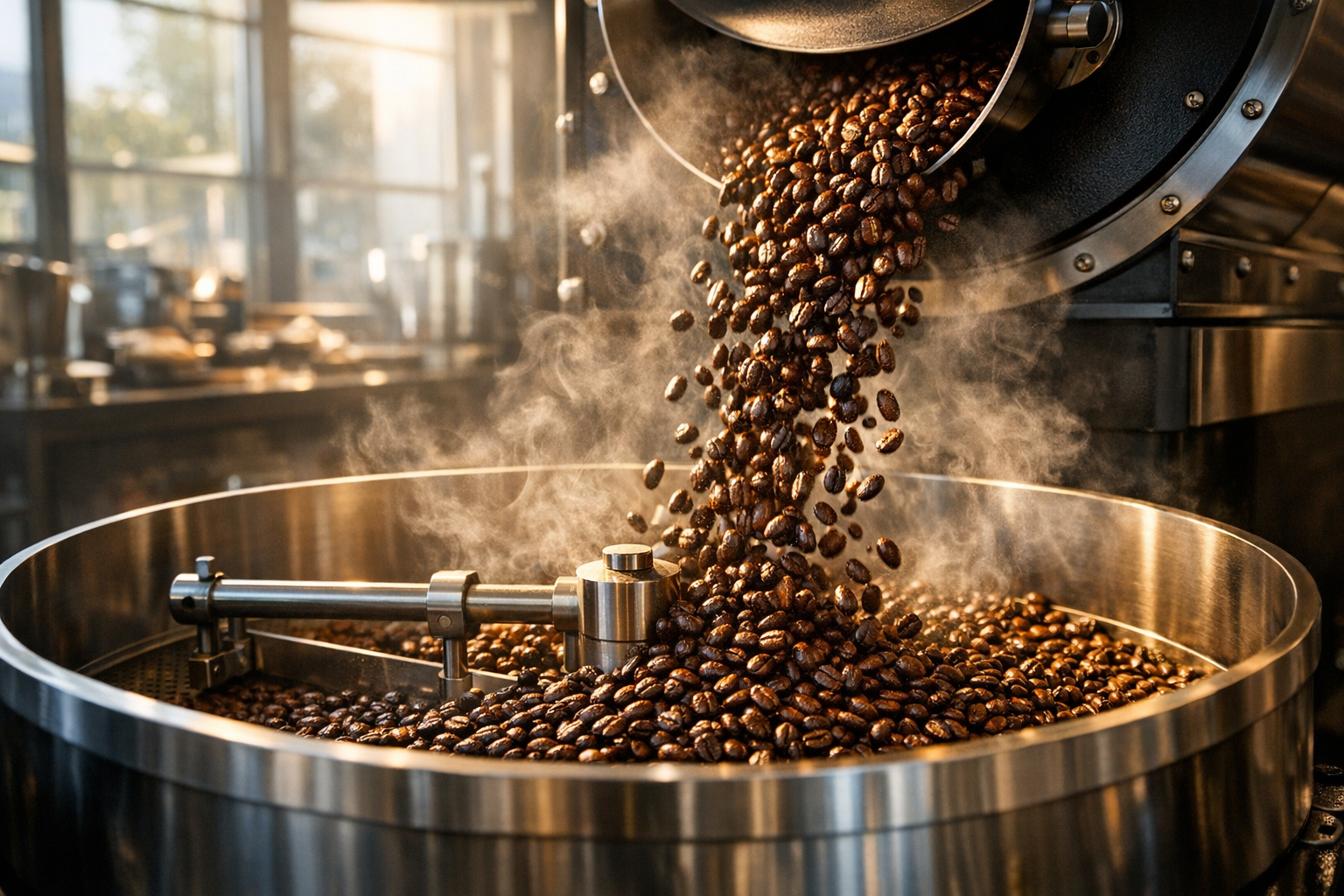
Instead of roasting vast quantities of coffee for speculative inventory, direct-to-consumer roasters process batches only in response to active customer orders. The coffee is bagged in packaging with one-way degassing valves and shipped within 24 to 48 hours. By the time freshly roasted coffee beans arrive at the customer's doorstep (typically days 3 to 5 post-roast), they have completed their necessary resting phase and perfectly aligned with the start of the peak flavor window.
Higher Grounds Coffee: A Human-Centered Approach to Freshness
For over two decades, Higher Grounds Coffee—based in Traverse City, Michigan—has championed an ethical, quality-obsessed coffee model. Leveraging their extensive specialty roasting experience, Higher Grounds demonstrates exactly why roast-to-order shipping outperforms commercial retail.
Small-Batch Roasting and Double-Cupping
Higher Grounds roasts entirely in small batches, dialing in custom profiles that highlight sweetness and origin clarity. To guarantee consistency, their process includes a rigorous "double-cupping" standard. Every microlot is evaluated at origin and then cupped again upon arrival in Traverse City by a team featuring a Licensed Q Grader and an Authorized SCA Trainer. Once vetted, every web order is roasted to order and shipped immediately to maximize flavor integrity.
Radical Transparency and Reinvestment
Beyond peak freshness, Higher Grounds intertwines cup quality with social dignity. As co-founders of Cooperative Coffees, they prioritize organic, direct-trade sourcing, paying well above Fair Trade minimums to producers. Through their Our Story and transparent open contracts, they showcase a commitment to the entire supply chain. Furthermore, through their sister non-profit, On the Ground, Higher Grounds actively reinvests profits into potable water systems, healthcare, and educational infrastructure across global coffee-growing regions.
The Bottom Line
The chemistry is undeniable: coffee is a highly perishable agricultural product. If your bag relies on an expiration date that is 12 months in the future, the delicate floral, fruity, and savory notes of those beans are already gone. To experience the true depth of specialty coffee, skip the grocery store aisle. Seek out roasters who prioritize transparency, source ethically, and ship fresh coffee beans directly to your door.