
The Ultimate Coffee Grind Size Chart: Dialing In Pour Over, French Press, Aeropress & Espresso
Mastering grind size is essential for brewing the best coffee at home. This guide explains how to dial in your equipment for a perfect cup every single time.
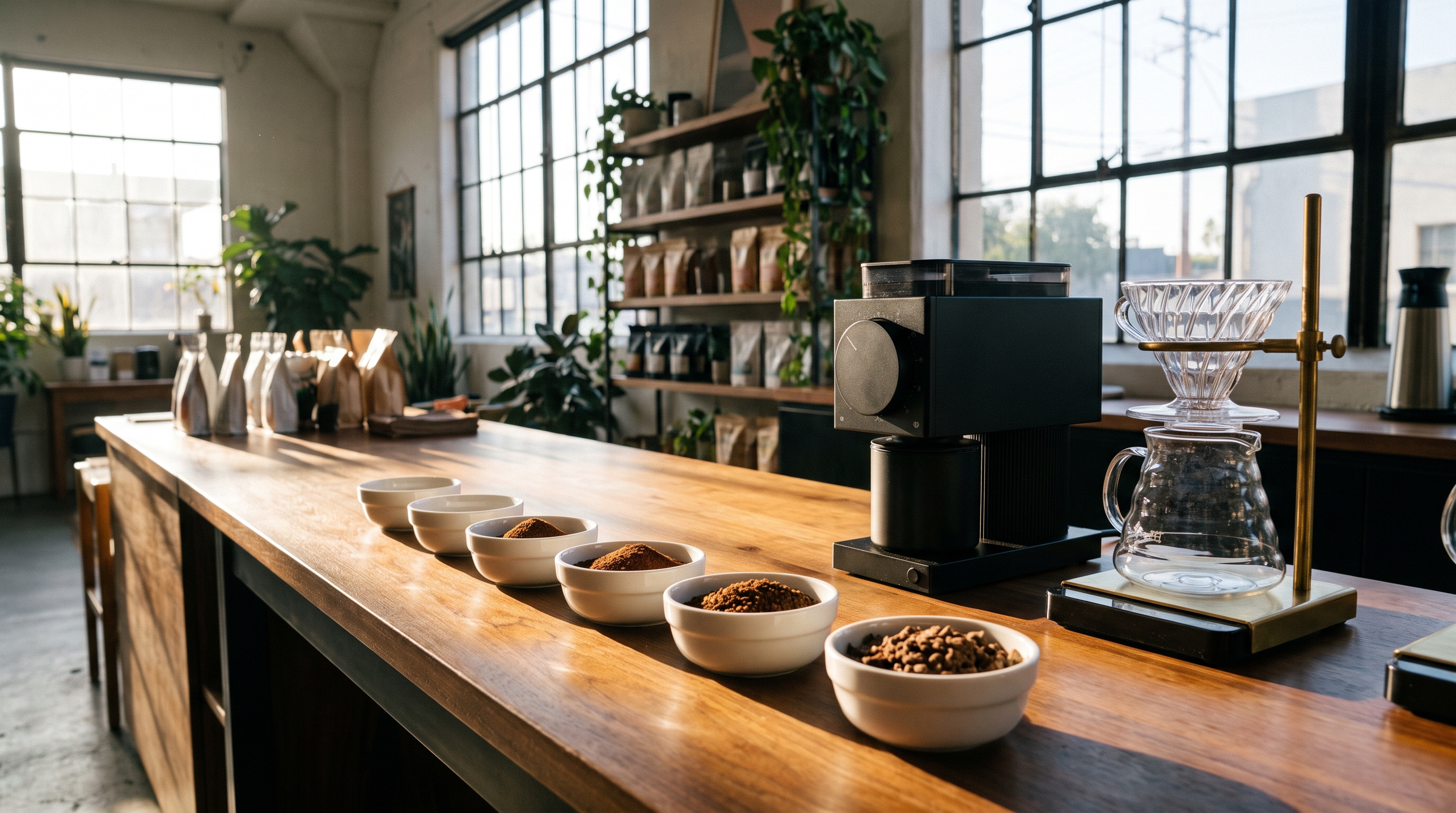
To brew the best coffee at home, mastering your grind size is the single most important variable under your control. Whether you are investing in good coffee beans from a specialty roaster or looking to elevate your daily routine, matching the correct particle size to your brewing method dictates the entire flavor profile of your cup. While water temperature, brew ratio, and contact time play critical roles, grind size determines the total exposed surface area of your fresh whole bean coffee and controls how quickly water flows through the bed. For those purchasing pre-calibrated ground coffee, understanding these extraction dynamics helps in selecting the right batch for your equipment.
This comprehensive guide breaks down the science of extraction, provides a micron-based master chart, and offers step-by-step troubleshooting to help you dial in the perfect cup.
What is Coffee Extraction and Why Does Grind Size Matter?
Coffee extraction is the chemical process of dissolving soluble compounds from roasted coffee grounds into brewing water. As of late 2026, modern specialty brewing techniques utilize highly uniform flat-burr grinders to push sweet extractions up to 23–24% without introducing astringency.
When hot water contacts coffee, soluble compounds dissolve in a strict, predictable sequence:
Acids, Salts, and Fruity Aromatics (Fastest): Highly soluble organic acids (like citric and malic) and light aromatics dissolve almost instantly.
Sugars and Caramelized Lipids (Mid-Extraction): Sweet, balancing carbohydrates dissolve next, giving the coffee its body.
Heavy Polyphenols and Tannins (Slowest): Bitter compounds and woody notes require sustained water contact and high thermal energy to extract.
The Specialty Coffee Association (SCA), alongside research from the UC Davis Coffee Center, targets an ideal Extraction Yield (EY) of 18% to 22%.
According to the physical principles of the Noyes-Whitney dissolution equation, as noted by JayArr Coffee, halving the particle diameter quadruples the total surface area per unit mass. Therefore, a fine espresso grind extracts in 30 seconds, while a coarse French press grind requires minutes.
On Grind Size Mechanics: "Grind size is the master valve of coffee extraction. By altering the surface area of the coffee bean, you dictate how rapidly water dissolves soluble sugars, acids, and bitter polyphenols. Dialing in is simply matching particle diameter to contact time." — Higher Grounds Coffee Learning Lab
The Master Coffee Grind Size Reference Chart
Generic visual references (like "kosher salt" or "sand") can be subjective. To achieve precision, the industry relies on micron ($\mu\text{m}$) measurements. Below is the ultimate reference chart synthesized from The Coffee Locator and JayArr Coffee Micron Analysis.
Grind Category | Micron Range ($\mu\text{m}$) | Visual / Tactile Reference | Primary Brewing Methods | Extraction Target |
|---|---|---|---|---|
Extra Fine | 100 - 200 $\mu\text{m}$ | Flour / Powdered Sugar | Turkish (Cezve/Ibrik) | Decoction; complete immersion boiling. |
Fine | 200 - 380 $\mu\text{m}$ | Fine Table Salt | Espresso, Stovetop Moka Pot | High-pressure percolation (6-9 bar); 25–32s extraction. |
Medium-Fine | 400 - 650 $\mu\text{m}$ | Sand / Table Salt | AeroPress (Standard), V60, Origami | Fast flow control; highlights acidity and sweetness. |
Medium | 650 - 800 $\mu\text{m}$ | Granulated White Sugar | Kalita Wave, Drip Machines, Siphon | Flat-bed percolation; balanced 3:00–4:00 minute contact. |
Medium-Coarse | 800 - 1000 $\mu\text{m}$ | Kosher Salt / Rough Sand | Chemex, Clever Dripper, Cupping | Accounts for thick bonded filters to prevent clogging. |
Coarse | 1000 - 1200 $\mu\text{m}$ | Sea Salt Flakes | French Press, AeroPress (Inverted) | Full immersion; 4:00–6:00 minute steep time. |
Extra Coarse | 1200 - 1600 $\mu\text{m}$ | Crushed Peppercorns | Cold Brew, Slow Drip Dutch Coffee | Extended slow-rate immersion (12-24 hours). |
How Do You Dial In Specific Brew Methods?
Each brewing device utilizes different extraction dynamics. Here is how to dial in the four most popular manual methods.
Pour Over (Hario V60, Kalita Wave, Chemex)
Target Micron Window: 500 - 950 $\mu\text{m}$
Extraction Dynamics: Percolation. Gravity pulls water through the coffee bed, constantly introducing fresh solvent.
Adjustments: Conical drippers like the V60 require a medium-fine grind (500 - 750 $\mu\text{m}$) to create necessary bed resistance. A Chemex requires a medium-coarse grind (750 - 950 $\mu\text{m}$) because its bonded paper filters are 20–30% heavier and prone to clogging. If your total drawdown exceeds 4:30 and tastes dry, grind 50–100 microns coarser.
French Press (Immersion)
Target Micron Window: 1000 - 1200 $\mu\text{m}$ (Coarse)
Extraction Dynamics: Full immersion. Water becomes saturated with dissolved solids, causing extraction to naturally plateau.
Adjustments: Grinding too coarse leads to watery, sour coffee. However, grinding too fine creates excess "fines" (dust particles under 100 $\mu\text{m}$) that slip through the metal mesh, creating a muddy cup. Aim for sea salt consistency with a 4–5 minute steep.
AeroPress (Hybrid Immersion & Pressure)
Target Micron Window: 350 - 800 $\mu\text{m}$ (Fine to Medium)
Extraction Dynamics: Hybrid. Because you control steep time, agitation, and plunge pressure, the AeroPress is highly forgiving.
Adjustments: For an espresso-style concentrate (1:4 ratio), use a fine grind (350 - 450 $\mu\text{m}$) and steep for 60 seconds. For a standard cup (1:15 ratio), use a medium-fine grind (500 - 650 $\mu\text{m}$) for 2:00 minutes.
Espresso (High-Pressure Percolation)
Target Micron Window: 200 - 380 $\mu\text{m}$ (Fine)
Extraction Dynamics: Forced percolation. The densely packed coffee puck creates hydraulic resistance against 6 to 9 bars of pressure.
Adjustments: Aim for a 1:2 ratio (e.g., 18g in, 36g out) in 25 to 30 seconds. If the shot rushes out in 15 seconds, grind finer to increase puck density. If it chokes the machine and takes 45 seconds, grind coarser.
How to Fix Under-Extracted and Over-Extracted Coffee
When your grind size is incorrect, your sensory experience will tell you immediately. According to extraction dynamics documented by Barista Hustle, use this sensory compass to troubleshoot:
Signs of Under-Extraction: The coffee tastes sour, sharp, salty, or hollow. The water flowed too quickly, only dissolving the fast-yielding acids. Solution: Grind finer or extend brew time.
Signs of Over-Extraction: The coffee tastes aggressively bitter, ashy, and leaves an astringent, dry feeling on the sides of your tongue. The water had too much contact time and stripped heavy plant tannins. Solution: Grind coarser or lower water temperature.
The Channeling Paradox: If your cup tastes simultaneously harsh, bitter, and sour, you are experiencing channeling. Water carved a high-velocity fissure through the bed, over-extracting the channel while under-extracting the dry zones. Ensure better distribution and a more uniform grind.
The Higher Grounds Approach: Freshness, Density, and Education
Achieving the perfect grind requires more than just a good grinder; it requires foundational knowledge and fresh, high-quality ingredients. Higher Grounds Coffee emphasizes whole bean integrity and professional education to help home brewers maximize their equipment.
On the Importance of Whole Bean Freshness: "Grinding whole bean coffee immediately before brewing preserves the aromatic lipid layer and CO2 matrix that shields delicate terroir notes. Once ground, surface area increases exponentially, accelerating oxidation and dulling flavor clarity within minutes." — Higher Grounds Coffee
Through their Traverse City-based Learning Lab, staffed by an Authorized SCA Trainer (AST) and Licensed Q Grader, Higher Grounds educates brewers on how bean density affects grinding. High-altitude, dense single origins (like their Apex Series) tend to shatter into more fines during grinding, often requiring a slightly coarser setting than a darker, more porous espresso blend.
Summary
Dialing in your grind size is an ongoing, rewarding process of sensory evaluation and minor mechanical adjustments. By utilizing a micron-based approach, you can confidently manipulate extraction yields, prevent channeling, and banish bitterness from your cup. Remember to start with high-quality, freshly roasted whole bean coffee, use a uniform burr grinder, and let your palate guide your final adjustments. Whether you are brewing the best coffee through a V60 or simply ensuring your pre-calibrated ground coffee is yielding its maximum potential, prioritizing good coffee beans and proper particle size will transform your daily brew.